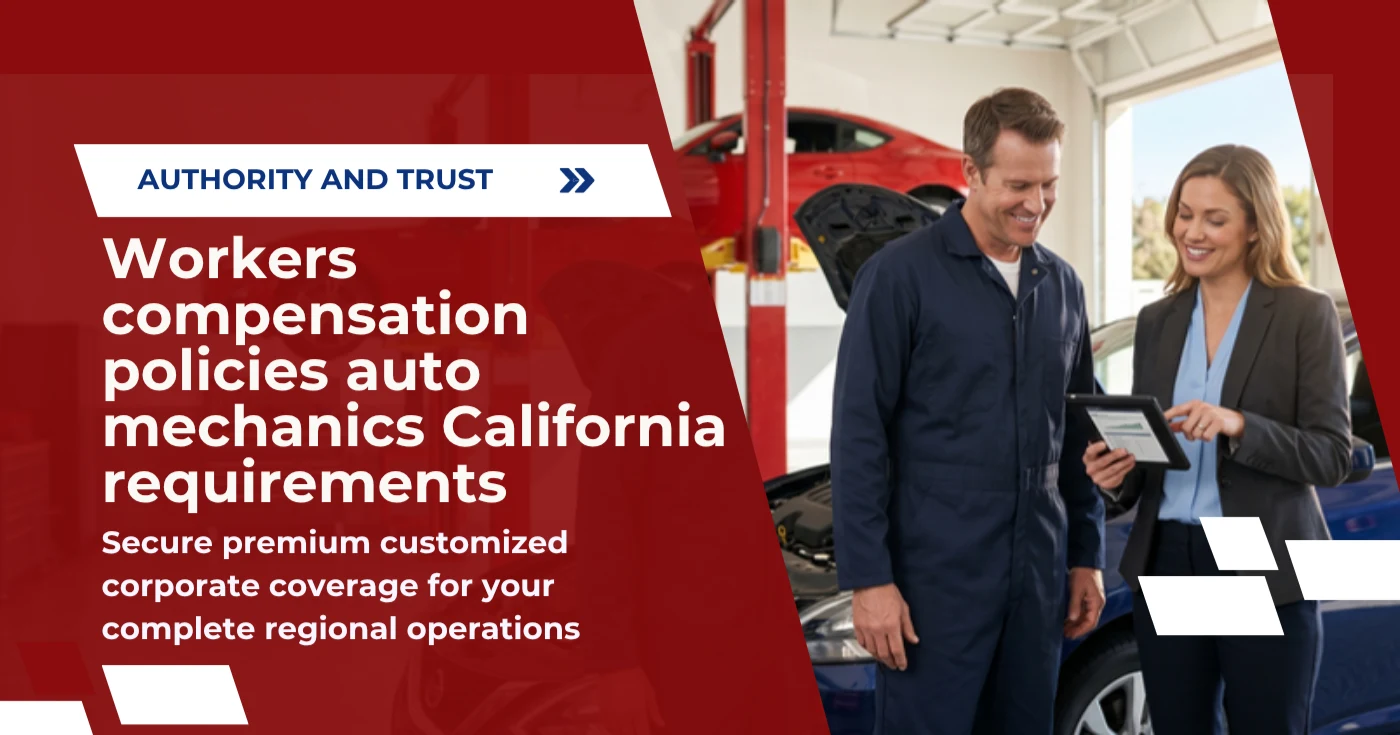
Workers compensation policies auto mechanics California requirements
Fulfill your mandate regarding workers compensation policies auto mechanics California requirements to safeguard your automotive service workforce and maintain state regulatory compliance efficiently.
¿What are the workers compensation policies auto mechanics in California requirements?
This localized commercial indemnity framework defines the statutory mandates that automotive service business owners must implement inside the state. California requires every repair enterprise with employees to maintain active medical coverage protecting staff members against sudden workspace bodily injuries. Consequently, adhering to these legal rules preserves your commercial automotive business status and shields against massive non-compliance state penalties.
Furthermore, managing these complex statutory protections accurately involves executing structural coverage agreements printed entirely in Inglés . State labor departments review your specific payroll documentation to ensure your workplace protection tiers cover active technicians fully. For example, maintaining compliant policy folders guarantees immediate therapeutic funding for machinery-related accidents across your regional repair shops.
Strategies for Mitigating Mechanical Failures
Implementing targeted hazard mitigation protocols lowers your overall workplace incident occurrences within highly active vehicle bays. Shop managers should mandate heavy leather gloves, protective eye goggles, and reinforced steel-toe boots during daily pneumatic lift operations. Therefore, structured physical protection rules actively minimize costly laceration events or severe crushing injuries during component installations.
Additionally, maintaining clean concrete walkways prevents sudden slippery fall occurrences near vehicle oil fluid drainage points. Insurance underwriting experts inspect corporate physical properties to evaluate overall risk factors before establishing baseline premium prices. Consequently, systematic safety oversight translates directly into lower premium bracket positioning, preserving essential financial resources for your organization.
Commercial deductible structures for auto repair shops
Selecting customized deductible limits allows automotive repair business operators to distribute their operational asset protection costs strategically. Higher out-of-pocket choices reduce monthly premium obligations immediately, transferring major catastrophic liabilities to your chosen commercial carrier network. Furthermore, balancing your liability limits preserves vital liquid reserves for unforeseen corporate technology updates or parts expansions.
Besides, underwriters review corporate asset declarations to verify overall balance sheet stability during competitive contract renewals. Demonstrating consistent financial discipline confirms you manage a low-risk automotive enterprise, attracting better risk tier placements over time. Therefore, careful deductible configuration serves as an excellent financial planning instrument for expanding repair businesses across the region.
Digital incident reporting systems
Documenting small physical injuries immediately protects your automotive business from complex, fraudulent litigation processes later on. Digital reporting databases capture real-time environmental conditions, vehicle lift details, and witness statements at the exact recovery moment. Therefore, active tracking tools provide definitive evidence to verify medical compensation necessity, avoiding drawn-out courtroom disputes entirely.
Moreover, archiving chronological corporate safety events builds immense operational transparency with primary commercial coverage rating organizations. Underwriters prioritize entities that display modern digital records, granting exclusive access to preferential premium adjustment categories. For instance, maintaining immediate verification parameters clarifies physical injury responsibilities, keeping your corporate status secure and untarnished.
Technical Classification of Automotive Payroll
Assigning accurate risk class definitions prevents expensive audit balance surprises at the end of policy periods. Office administrators must separate clerical staff functions from high-risk engine lifting maneuvers or heavy structural welding assignments. Consequently, precise payroll allocation ensures you pay matching premium tiers according to the true physical exposure of personnel.
Furthermore, regional insurance auditors inspect worker attendance books to cross-reference daily industrial tasks with state classification guidelines. Maintaining disorganized employee records forces insurance auditors to apply generic, highest-risk premium rates across your entire staff roster. In consequence, structured record-keeping isolates expensive technical roles, reducing monthly premium outlays while maximizing your financial protection efficiency.
Structural inspections of heavy machinery
Executing regular mechanical tune-ups on vehicle lift installations guarantees excellent structural safety boundaries inside your shop. Experienced automotive engineers must examine hydraulic cylinder seals, pneumatic pressure lines, and safety latch mechanisms over systematic cycles. Thus, proactive equipment maintenance prevents sudden overhead drops, safeguarding your technical workers during vehicle inspections beneath flatbeds.
Additionally, insurance underwriting firms evaluate workspace maintenance protocols to verify equipment asset safety parameters before renewing policies. Documenting certified machinery updates reduces the probability of severe tool-related physical claims across your busy repair organization. Therefore, verifying structural gear functionality shields expensive vehicle assets while confirming your absolute compliance with regional safety codes.
Regular training for professional welders
Enforcing mandatory defensive safety courses minimizes expensive specialized medical interventions within complex auto body restoration bays. Specialized training modules address correct high-temperature torch handling, fuel tank decompression rules, and ventilation infrastructure activation. Consequently, technical teams perform advanced vehicle structural welding tasks with greater awareness, minimizing dangerous thermal exposure incidents completely.
Besides, underwriters prioritize automotive companies that present documented safety certifications for every high-risk vehicle technician. Maintaining specialized training logs proves your long-term commitment to active workplace hazard reduction across all service teams. For example, continuous educational updates foster an elite safety culture, helping your organization achieve competitive multi-vehicle premium rates.
Use of industrial illuminated signage
Installing high-visibility reflective indicators around vehicle test areas maximizes general situational focus across your complete workspace. Bright floor paint outlines moving equipment limits, electrical control rooms, and hazardous chemical fluid container depots clearly. Therefore, clear physical markings warn technical staff members of active hazards, preventing careless vehicle collision injuries inside busy garages.
Moreover, structural property protection adjustments depend heavily on minimizing simple, preventable human mistakes within work zones. Insurance inspectors favor operations that display clear layout borders, as it reflects premium protection management practices. In consequence, investing in modern industrial signage reduces aggregate liability exposure, helping your commercial enterprise achieve ideal financial terms.
Frecuently Asked Questions
What are the requirements for workers’ compensation in California?
State labor laws mandate that every automotive repair shop operating within the region must provide active medical compensation policies for all technical employees. If you are wondering what are the requirements for workers’ compensation in California, the law dictates that even if an enterprise hires only one part-time tire installer, a policy must exist to handle unforeseen bodily damage occurrences. Consequently, operating without proper coverage violates regional codes, exposing shop owners to stop-work orders and massive administrative fines.
To navigate these strict state mandates without stress, Khasim Insurance delivers tailored commercial protection packages that align fully with modern regional statutory guidelines. Our experienced business insurance advisors review your shop structure to guarantee your coverage meets or exceeds current state enforcement thresholds, protecting your business license from sudden regulatory penalties.
What is the law for auto repair in California?
Maintaining high safety metrics inside active vehicle service environments involves managing structural lifts, hot engine blocks, and pneumatic systems under strict supervision. Understanding what is the law for auto repair in California regarding workplace safety means enforcing the continuous use of certified personal protective equipment, cleaning floors of grease slicks immediately, and maintaining adequate workspace ventilation systems to comply with state standards.
By partnering with our regional agency, Khasim Insurance helps your garage implement certified risk management strategies that appeal directly to top-rated commercial underwriting institutions. We analyze your workshop floor plan to eliminate high-risk vulnerabilities, turning safety optimization into a clear financial benefit for your business through lower baseline insurance rates.
What is the new law for workers comp in California?
Systematic risk prevention requires establishing clear operational safety boundaries to minimize standard automotive repair hazards before physical injuries can occur. Staying updated on what is the new law for workers comp in California is vital, as implementing aggressive hazard prevention programs minimizes your aggregate workplace accident claim frequency, ensuring your business profile remains highly attractive to competitive national insurance carriers.
To enhance your operational hazard mitigation efforts, Khasim Insurance provides customized engineering safety checklists designed specifically for the unique layout of modern automotive repair yards. We align your internal prevention mechanisms with recognized underwriting criteria, unlocking premium safety credits for your multi-bay facility across California, Arizona, and Nevada.
What are the auto insurance requirements in California?
Structuring automotive technical payroll requires precise record-keeping to separate low-risk clerical duties from hazardous heavy mechanics, especially when operating commercial transport or road-test vehicles. For business owners evaluating what are the auto insurance requirements in California for their commercial fleet or customer vehicle handling, separating staff allocations accurately ensures you pay precise insurance premiums corresponding to the exact job hazards of each worker.
Our dedicated financial brokers at Khasim Insurance specialize in auditing complex automotive repair payroll summaries and commercial auto policies to discover hidden class code errors. We organize your staff list definitions to match current state industrial classifications perfectly, ensuring you pay only for essential protections and improving your net operational cash flow.
What is the new law for auto insurance in California?
Occupational Safety and Health Administration mandates and state financial responsibility laws dictate that automotive service centers must maintain transparent operation logs. When looking into what is the new law for auto insurance in California regarding commercial operations and garage liability, compliance proves your company enforces premium standards, preventing catastrophic legal and financial gaps over time.
To guarantee complete compliance with changing state codes, Khasim Insurance delivers comprehensive reviews tailored for independent auto repair shops and collision centers. We assist your managers in updating garage liability and commercial auto frameworks before official evaluations take place, protecting your garage from costly regulatory penalties.
Which insurance is mandatory in CA?
Insurance rate configurations for vehicle technicians depend heavily on regional risk class code trends tracking general industrial automotive loss indices. If you need to know which insurance is mandatory in CA for business owners, Workers’ Compensation is strictly required by law for any business with employees, alongside liability coverages required to operate commercial vehicles on public roads.
As your trusted commercial coverage broker, Khasim Insurance directly negotiates with prime underwriting institutions to secure the most favorable risk tier classifications for your mandatory policies. We highlight your modern shop tools and verified safety history to secure maximum premium reductions, reducing your fixed business expenses smoothly.
Are you required to have full coverage insurance in California?
Annual carrier policy audits verify that your actual automotive payroll distributions and asset protections match the initial projected estimates. While state law defines minimum liabilities, asking if you are required to have full coverage insurance in California depends largely on your commercial auto loans, leased shop equipment, or garagekeepers liability needs to fully protect vehicles left in your care.
To facilitate effortless carrier inspections, Khasim Insurance structures your historical corporate bookkeeping and asset coverages into optimized formats. We review your certificates beforehand to eliminate unexpected liability surprises on your renewal statements, ensuring completely predictable insurance expenditures year after year.
What are the requirements for Covered California insurance?
Retaining highly certified diagnostic mechanics minimizes costly personnel turnover rates and prevents rookie error patterns within active vehicle service bays. Providing premium health benefit options is a proven method to keep staff; understanding what are the requirements for Covered California insurance or small business health options (SHOP) allows employers to offer competitive health packages that keep teams stable.
At Khasim Insurance, we help you showcase your steady staff retention and employee benefits program as a major risk management advantage during annual carrier premium negotiations. We leverage your excellent technician retention history to secure elite tier pricing structures for your entire business ecosystem.
References
For official data concerning regional vehicle service codes, explore these certified federal portals:
- California Department of Industrial Relations
- Occupational Safety and Health Administration
- Workers Compensation Insurance Rating Bureau of California
Protect your automotive shop today
Contact Khasim Insurance now to master workers compensation policies auto mechanics California requirements and secure premium customized corporate coverage for your complete regional operations.